Cup six · peg 6
The Last Cup Back on the Rack
last one in · day looked over
The rack is full again only when the last cup is hung up. We use that small moment as a signal to look the day over, backwards, before it is gone.
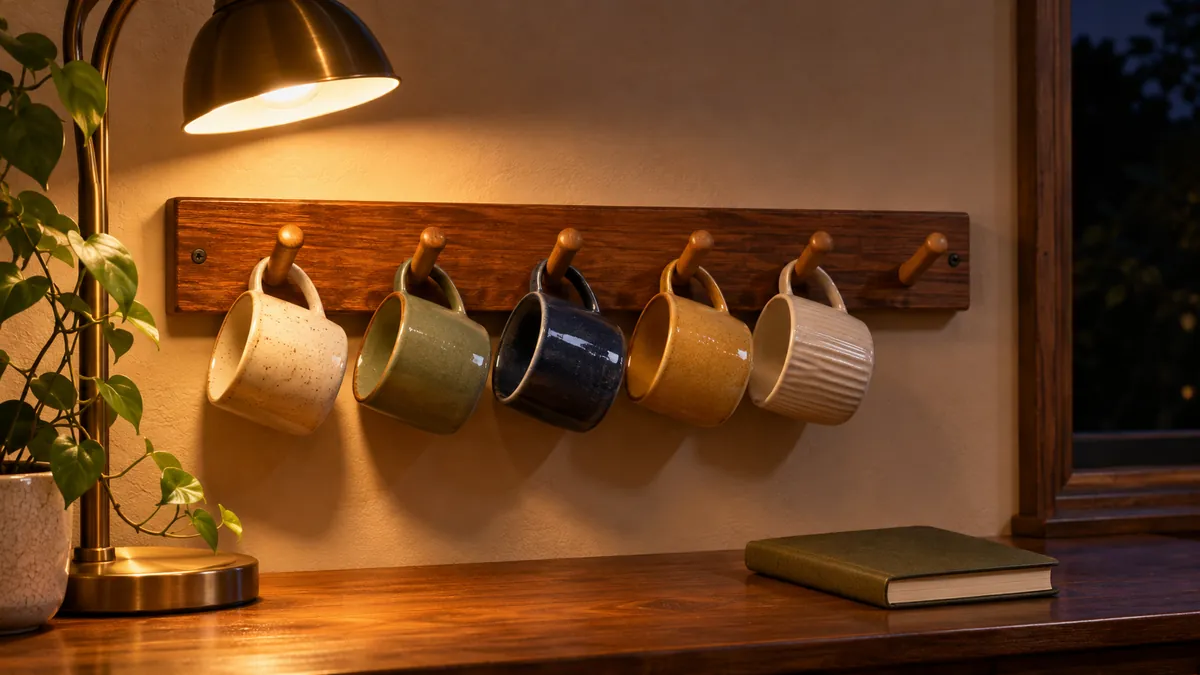
The empty peg
A drying rack tells the time if you know how to read it. In the morning it is full. By noon the pegs are bare. In the evening, cup by cup, it fills again, and the last cup to go back on its hook marks the end of the kitchen day. We have always liked that moment. Nothing more needs to be done in the room after it.
Cup six is whichever cup goes back last. The habit that goes with it is a short review of the day, done in reverse, standing at the rack or sitting nearby.
Backwards, not forwards
Start with the most recent thing. Washing the cups. Before that, dinner. Before that, the phone call. Before that, the walk. Keep going back, step by step, until you reach the moment you took the first cup down this morning. It usually takes three or four minutes.
Running a day in reverse is harder than running it forwards, and that is the reason to do it. The mind cannot coast on the order it lived things in. It has to reach for each step on purpose. People who use the habit often say the first nights feel clumsy and full of gaps, and that after a couple of weeks the gaps get smaller.
Close the loop with the morning card
If you keep the three-line card from cup one, look at it now. Did the thing that had to happen today happen? Did you see the person whose name you wrote? Put a small mark beside each line. Tomorrow morning, when you write the new card, yesterday's marks are right there to remind you what is still open.
The two cups, first and last, become bookends. One opens the day with a short plan. The other closes it with a short look back. Between them, the day has a shape.
Then hang it up and stop
The review is not a test and there is no score. If a part of the day will not come back, let it go and hang the cup on its peg anyway. The habit works by repetition, not by perfection. A full rack and a closed notebook are a good place to leave things until morning.
A note for partners and housemates
If you share the kitchen, the review can be done aloud with whoever hangs up the other cups. Take turns naming one step of the day, going backwards together. You will be surprised how often the other person remembers the piece you lost, and how often you supply theirs. Two memories working the same day from opposite ends tend to meet in the middle with very little left out. It also makes a pleasant few minutes out of a chore that would otherwise be done in silence, and it gives the household one more small ritual that belongs to everyone who lives there.